
The separation few mothers are warned about, and the work that helps it close.

By Pranav Raut, postpartum coach for NRI mothers.
The short answer
Diastasis recti is a separation of the two long bands of abdominal muscle that run down the front of your belly, with the connective tissue between them stretched and thinned. It happens during pregnancy because the abdominal wall has to make room, and to some degree it happens to almost everyone.
It isn’t fat or a weight problem, so dieting won’t change it. Rebuilding the deep core in the right order will, with the pelvic floor trained alongside it.
With that work the gap narrows for most mothers, and many close it over the following six to twelve months. Some separation can remain, particularly after more than one pregnancy, and that isn’t a failure.
How to know if you have one
The usual sign is a belly that still pushes outward, especially in the evening, or a ridge that shows down the middle when you sit up from lying down.
Mothers also describe a soft, hollow feeling above the navel, a sense that the middle gives way when you lift something, and a low back ache that arrived after the birth and never left.
- You can screen for it yourself in two minutes.
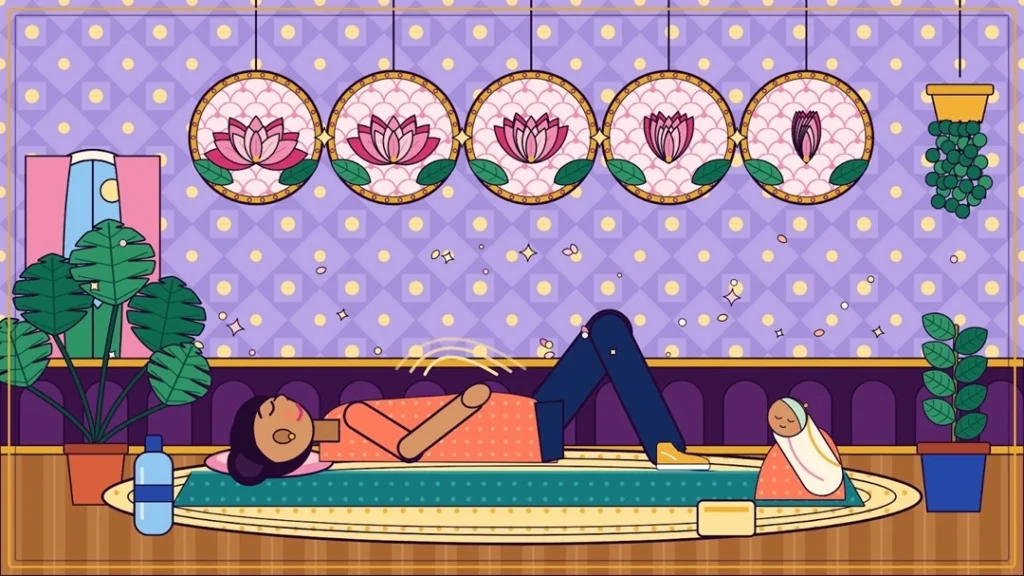
- Lie on your back with your knees bent and your feet flat on the floor.
- Place two fingers flat above your navel, pointing towards your feet.
- Lift your head and shoulders slightly off the floor, the way the start of a small curl-up feels.
- As you lift, press your fingers gently into the midline and feel for a gap between the two firm ridges of muscle.
- Check at the navel first, then a little below it.
Note two things: how many finger-widths wide the gap is at its widest point, and whether there’s a firm floor beneath your fingers or it feels soft and deep.
This is an informal self-screen, not a diagnosis. If the gap is two finger-widths or wider, or it feels soft and deep with no firm floor beneath your fingers, get it assessed by a healthcare professional or a women’s health physiotherapist. Write down where it feels widest and how many fingers it holds. That’s your starting measurement.
Depth matters as much as width, and often more. A narrower gap with no tension underneath is a bigger problem than a slightly wider gap that feels firm.
Why crunches make it worse
The instinct here is the wrong one, and it costs mothers a lot of time.
A crunch raises the pressure inside your abdomen and pushes it outward against the midline. When the tissue there is already stretched and thin, repeated pressure works against what you’re trying to achieve.
So the rule is short. No crunches, no sit-ups, and nothing that makes your belly dome or push outward down the middle, until the gap has closed.
If you delivered vaginally and your gap has closed, those movements can come back later. If you had a caesarean, or you still have a gap, leave them alone for now.
The same goes for anything else that causes doming: a badly held plank, a heavy lift you brace wrongly for, or sitting up sharply from lying instead of rolling to your side first. Watch your own belly during any movement. If the middle rises like a ridge, that movement isn’t for you yet.
What helps
The work is unglamorous and done lying on the floor, and it’s the work that changes things.
- Diaphragmatic breathing. Lying with knees bent, five minutes. Breathe into the ribs and the belly rather than the chest, and let the exhale run long. It reconnects you to the deep core muscle that wraps around your middle, and everything else is built on it.
- Pelvic floor lifts. Gentle lifts of the muscles you’d use to stop the flow of urine, two sets of ten. Use the stop-the-flow idea once or twice to find them, and no more. Don’t practise while you’re passing urine, because doing that regularly can interfere with emptying the bladder fully.
- Pelvic tilts. Two sets of fifteen, done slowly.
- Supine heel slides. Two sets of ten. The skill here is keeping the midline stable while a leg moves.
- Slow glute bridges. Two sets of ten.
- Child’s pose with deep breaths, two minutes.
Every session ends with pelvic floor work. Your core and your floor were weakened together and they’re rebuilt together, which is why good programmes never separate them.
Three or four short sessions a week is enough. Volume isn’t the problem.
A word about the pelvic floor
The pressure that pushed your belly outward was also pressing downward for nine months, on the sling of muscle at the base of your pelvis.
Few mothers are warned about this, so few train it. A weak pelvic floor can contribute to leaking when you laugh, cough or lift, and an untrained one tends to fare worse over time, often after a second or third pregnancy.
It responds well to the right work. Pelvic floor muscle training is the first-line recommendation for stress urinary incontinence, and with consistent work over roughly two months most women improve.
Train it whether you’re leaking or not. Now is the cheapest time.
What’s realistic
A promise that doesn’t hold helps nobody, so here’s what to expect.
The gap narrows for most mothers who do this work, and many close it over six to twelve months. Some separation can remain, particularly after more than one pregnancy or a large baby. A remaining gap isn’t a failure, because a narrower gap with good tension underneath functions well.
What the work reliably offers is steady improvement, in a way that doesn’t make the separation worse. That’s why I won’t promise a flat stomach by a given date, and why you should be sceptical of anyone who does.
When to see someone in person
Get your healthcare professional’s clearance before you start core and floor work, particularly after a caesarean.
Ask for a referral to a women’s health physiotherapist if you feel heaviness or dragging low in the pelvis, notice a bulge, have a gap that feels soft and deep, or find the leaking isn’t improving after a couple of months of consistent work.
A physiotherapist can assess your floor directly and guide you in person, which no book or article can do. This isn’t a place to guess.
Frequently asked questions
How do I know if my diastasis is closing?
Repeat the self-check once a month under the same conditions, and track both the width and whether the tissue underneath feels firmer. Firmness usually improves before width does.
Can diastasis recti close on its own?
Some narrowing happens naturally in the months after birth. After that, the deep core work is what drives further change.
Do I need surgery?
Most mothers don’t. Surgical repair is a conversation for a doctor, usually where there’s a large separation with functional problems that conservative work hasn’t improved. Start with the physiotherapist.
Is it too late if I am years postpartum?
No. The work is the same whether you’re four months or four years out, and the tissue responds to training either way.
Can I exercise with a separation?
Yes, and you should. Walking, lower body work, upper body work and the deep core sequence are all open to you. What you avoid is any loading that causes doming.
The one line to take away
If your belly pushes outward, more crunches is the wrong instinct. Check the midline first, then train the deep core and the pelvic floor together.
Where to go next
Parent Fitness Coach on Instagram carries our latest postpartum guidance and the experiences of the mothers we coach.
Follow on Instagram: Click Here
If you’d rather start from a written plan, How to Get Your Pre-Pregnancy Body Back in 90 Days carries the full deep core and pelvic floor progression across ninety days, with a separate caesarean track and the self-check written out in detail.
Get the ebook: Click Here
If your self-check found two finger-widths or more, or a soft, deep gap, have it assessed in person before you build a plan around it. That’s a physiotherapist’s job.
If you want it considered alongside your training and nutrition together, you can book a one-to-one consultation call.
Book a one-to-one call: Click Here
Mothers describe their experience in their own words in this video interview series.
Watch the interviews: Click Here
About the author

Pranav Raut is a postpartum coach for NRI mothers and the founder of Parent Fitness Coach and the Reverse Fat System. A certified nutritionist, he has spent six years in the postpartum space and coached more than 1,000 working mothers, including NRI mothers in the USA, Canada, the UK, Switzerland, Iceland, Singapore, Doha and Dubai.
This article is for education and is not medical advice. Do not ignore the advice of your healthcare professional.